

Published: 16 March 2012
The population of Finland grew most in 20 years
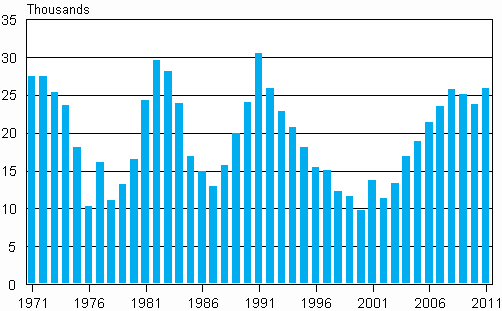
According to Statistics Finland's statistics on the population structure, the official total population of Finland at the end of 2011 was 5,401,267, of whom 2,652,534 were men and 2,748,733 women. In the course of 2011, Finland’s population grew by 25,991 persons, which is the largest figure since 1991. For the fifth successive year migration gain from abroad contributed more to the increase of population than natural growth.
Change in the population of Finland in 1971 to 2011
The population in North Karelia and Pohjois-Savo grew for the first time in 18 years
During 2011 the population grew in 13 and shrunk in six regions. The population in the regions of North Karelia (+40 persons) and Pohjois-Savo (+187 persons) grew for the first time since 1993. The population in Ostrobothnia grew during 2011 by 1,160 persons, which is in absolute numbers most after 1982.
In absolute numbers the population grew most in the regions of Uusimaa, by 16,749 persons, and Pirkanmaa, by 3,549 persons. In relative terms the population grew most in the regions of Åland, by 1.2 per cent, and Uusimaa, by 1.1 per cent.
In absolute numbers the population decreased most in the regions of Etelä-Savo, by 930 persons, and Kainuu, by 775 persons. In relative terms the population decreased most in the regions of Kainuu, by 0.9 per cent and Etelä-Savo, by 0.6 per cent.
During 2011, the population grew in 131 and diminished in 204 municipalities. Helsinki had the biggest absolute increase in population (6,835 persons), followed by Espoo (4,469 persons) and Vantaa (2,946 persons). Kouvola had the biggest absolute decrease in population (505 persons), followed by Suomussalmi (213 persons) and Saarijärvi (200 persons). Examined by municipality in Mainland Finland, Pirkkala and Lieto had the largest relative increases in population of 3.1 per cent and 2.6 per cent, respectively. Examined by municipality in Mainland Finland, the largest relative decreases in population occurred in Luhanka, down by 3.5 per cent and Pelkosenniemi, by 3.5 per cent.
Demographic dependency ratio highest in Etelä-Savo and South Ostrobothnia
At the end of 2011, Finland had 888,982 persons aged 15 or under, 3,532,645 persons aged 15 to 64 and 979,640 aged 65 or over. The demographic dependency ratio, that is, the number of those aged 15 or under and 65 or over per 100 working age persons was 52.9 at the end of 2011. The demographic dependency ratio was last higher than this in 1966. During our independence, the demographic dependency ratio has been at its highest at 67.6 in 1917 and at its lowest at 46.7 in 1984.
Examined by area, the demographic dependency ratio was highest in the regions of Etelä-Savo, 61.1, and South Ostrobothnia, 60.0. The demographic dependency ratio was lowest in the region of Uusimaa, 46.0. Examined by municipality, the demographic dependency ratio was highest in Luhanka, 91.0, Kivijärvi, 82.7, and Multia, 82.6, and lowest in Helsinki, 40.8, Tampere, 43.4, and Oulu, 43.5.
The demographic dependency ratio by region 1981–2011
| Region | Year | |||
| 1981 | 1991 | 2001 | 2011 | |
| WHOLE COUNTRY | 47,2 | 48,8 | 49,5 | 52,9 |
| Uusimaa | 44,0 | 42,7 | 43,0 | 46,0 |
| Varsinais-Suomi | 49,3 | 50,2 | 50,2 | 53,6 |
| Satakunta | 48,0 | 50,1 | 52,5 | 58,9 |
| Kanta-Häme | 48,3 | 51,5 | 54,0 | 57,0 |
| Pirkanmaa | 47,1 | 48,9 | 49,5 | 52,5 |
| Päijät-Häme | 46,6 | 47,4 | 49,7 | 55,9 |
| Kymenlaakso | 46,6 | 48,9 | 52,4 | 57,5 |
| South Karelia | 46,9 | 49,0 | 52,2 | 57,2 |
| Etelä-Savo | 47,2 | 51,4 | 55,0 | 61,1 |
| Pohjois-Savo | 47,4 | 51,1 | 52,5 | 55,4 |
| North Karelia | 46,8 | 52,1 | 52,7 | 55,2 |
| Central Finland | 47,2 | 50,9 | 50,6 | 54,5 |
| South Ostrobothnia | 51,7 | 56,9 | 57,3 | 60,0 |
| Ostrobothnia | 54,1 | 56,7 | 56,0 | 58,7 |
| Central Ostrobothnia | 52,5 | 54,8 | 54,0 | 59,3 |
| North Ostrobothnia | 50,2 | 53,5 | 51,6 | 55,5 |
| Kainuu | 45,0 | 49,7 | 52,8 | 57,6 |
| Lapland | 44,5 | 48,5 | 50,6 | 54,2 |
| Åland | 55,0 | 53,0 | 53,6 | 54,5 |
Number of foreign-language speakers close to the number of those speaking Swedish as their native language
Of the population of Finland, 4,863,351 persons (90.0%) spoke Finnish, 291,219 persons (5.4%) Swedish and 1,870 persons (0.03%) Sami as their native language. Persons with a native language other than Finnish, Swedish or Sami numbered 244,827, or 4.5 per cent of the population. The largest foreign-language groups spoke Russian (58,331 persons), Estonian (33,076 persons), Somali (14,045 persons), English (13,804 persons) and Arabic (11,252 persons).
At the end of 2011, the number of Finnish citizens permanently resident in Finland was 5,218,134, of whom 101,306 had been born abroad. Foreign citizens resident in Finland numbered 183,133, or 3.4 per cent of the population.
Source: Population Structure 2011, Statistics Finland
Inquiries: Markus Rapo 09 1734 3238, vaesto.tilasto@stat.fi
Director in charge: Jari Tarkoma
Publication in pdf-format (341.4 kB)
- Tables
-
Tables in databases
Pick the data you need into tables, view the data as graphs, or download the data for your use.
Appendix tables
- Figures
-
- Appendix figure 1. Population in Finland 1750 - 2011 (16.3.2012)
- Appendix figure 2. The largest groups by native language 2001 and 2011 (16.3.2012)
- Appendix figure 3. Foreign nationals by sex 1980 - 2011 (16.3.2012)
- Appendix figure 4. Country of birth, citizenship and mother tongue of the population 31.12.2011 (16.3.2012)
- Quality descriptions
-
- Quality description: Population structure 2011 (16.3.2012)
Updated 16.3.2012
Official Statistics of Finland (OSF):
Population structure [e-publication].
ISSN=1797-5395. 2011. Helsinki: Statistics Finland [referred: 19.4.2024].
Access method: http://www.stat.fi/til/vaerak/2011/vaerak_2011_2012-03-16_tie_001_en.html?tulosta