

Pay differentials contracted slightly in 2009
According to Statistics Finland’s Structure of Earnings statistics, the average monthly earnings of all full-time wage and salary earners were EUR 2,971 in the last quarter of 2008 and the median 1) earnings were EUR 2,645. The earnings of the best paid tenth (9th decile) of wage and salary earners exceeded EUR 4,407 while the lowest paid tenth (1st decile) earned less than EUR 1,892 per month. Thus, the best paid decile earned at least 2.33 times more than the decile with the lowest earnings. The difference in earnings between the highest and the lowest decile decreased by around one percentage point from the previous year.Distribution of monthly earnings of full-time wage and salary earners in 2009
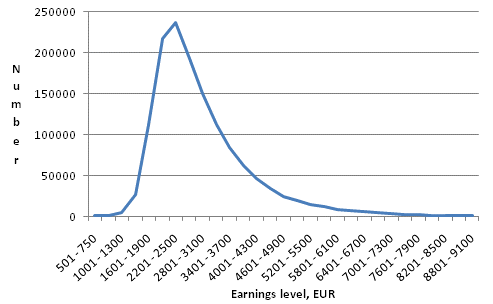
The observed contraction of pay differentials was mainly due to slowed down development in the earnings of well-paid wage and salary earners in 2009. The earnings of the best paid decile rose by 2.8 per cent in the year while at the same time the earnings of the lowest paid decile went up by 3.6 per cent.
In Uusimaa, pay differentials narrowed approximately one per cent from the previous year, and this also had a significant impact on the contraction of the pay differential at the level of the whole country. Uusimaa has the largest pay differentials and it is also the region with the strongest influence on the development of the pay differential because over 30 per cent of all wage and salary earners work in Uusimaa.
These data derive from Statistics Finland’s Structure of Earnings statistics, which cover all employer sectors. Monthly earnings for total hours worked are only calculated for full-time wage and salary earners. Besides earnings for regular working hours, the earnings also include pay for any possible overtime and working hour supplements but not one-off performance-based bonuses.
Source: Structure of Earnings 2009, Statistics Finland
Inquiries: Mika Idman (09) 1734 3445, Jukka Pitkäjärvi (09) 1734 3445, palkkarakenne@stat.fi
Director in charge: Kari Molnar
Updated 8.4.2011
Official Statistics of Finland (OSF):
Structure of Earnings [e-publication].
ISSN=1799-0092. 2009,
Pay differentials contracted slightly in 2009
. Helsinki: Statistics Finland [referred: 10.6.2026].
Access method: http://stat.fi/til/pra/2009/pra_2009_2011-04-08_kat_001_en.html