

This set of statistics has been discontinued.
New data are no longer produced from the statistics.
Published: 22 March 2012
Growing number of people in Finland are highly educated
Corrected on 26 March 2012. The correction is
indicated in red. Was previously non-tertiary.
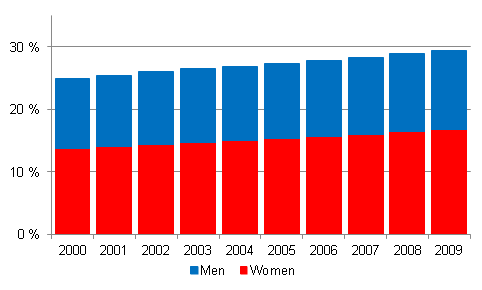
According to Statistics Finland, 1,166,000 persons in Finland had
tertiary level educational qualifications in 2009, which is nearly
30 per cent of the country’s population aged 16 to 74.
Throughout the 2000s, the share has been growing at the annual rate
of half-a-percentage point. Women’s share in the highly
educated population was 57 per cent. This share, too, has been
growing steadily by some two percentage points in a decade. A
person with at least post-secondary, non-higher vocational qualification is classified
as highly educated.
Share of population aged 16 to 74 with tertiary level degrees in 2000-2009
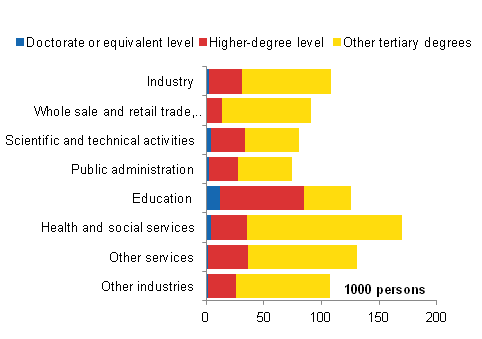
Of the population with tertiary level degrees, one-fifth - 87 per cent of them women - worked in human health and social work activities. Education employed 14 per cent (67% women), manufacturing 12 per cent (33% women) and trade, and hotel and restaurant activities one in ten (56% women) of the persons with high education.
Persons with tertiary level degrees by industry in 2009
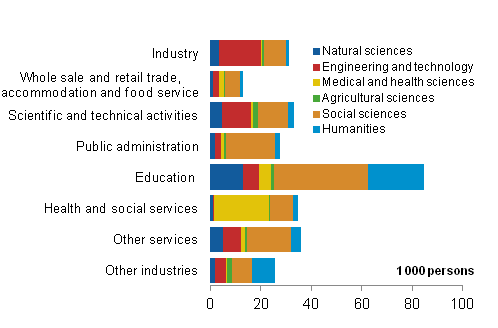
Forty-one per cent of those with higher university or doctorate level degrees had attained their degree in the field of social sciences. One-third of them worked in education. Those with degrees in the field of technology found jobs best in manufacturing, which employed one-third of them, and in professional, scientific and technical activities, which provided jobs for one-fifth of the most highly educated in the field of technology. Fifteen per cent held degrees in humanities and arts and one in two of them worked in education. Likewise, a large share, or 40 per cent, of degree holders in natural sciences were employed in education. Two out of three of the holders of degrees in medical and health sciences were employed by human health and social work activities.
Holders of higher university or doctorate level degrees by economic activity and field of science in 2009
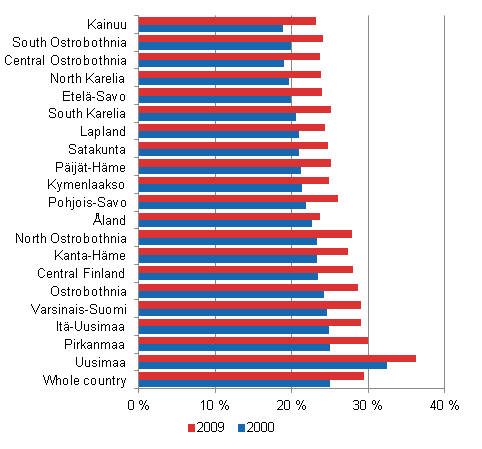
Thirty-four per cent of the highly educated population lived in the region of Uusimaa , nine per cent in both Varsinais-Suomi and Pirkanmaa and seven per cent in North Ostrobothnia. From the year 2000, the share of the highly education population grew by an average of 4.4 percentage points in the whole country. Differences between the regions were mainly minor. The biggest growths in the share were seen in the regions of Pirkanmaa and Central Ostrobothnia. The share of highly education population grew by least in the regions of Kymenlaakso, Lapland and Åland.
Share of population aged 16 to 74 with tertiary level degrees by region in 2000 and 2009
Source: Human resources of science and technology 2010. Statistics Finland
Inquiries: Marianne Kaplas 09 1734 3421
Director in charge: Leena Storgårds
Publication in pdf-format (11 pages 332.3 kB)
- Tables
-
Tables in databases
Pick the data you need into tables, view the data as graphs, or download the data for your use.
Appendix tables
- Appendix table 1. Tertiary degrees by the field of science in 1991, 2000 and 2010 (22.3.2012)
- Appendix table 2. Population with a tertiary degree in 2000 and 2009 (22.3.2012)
- Appendix table 3. Population with a tertiary degree by principal activity in 2009 (22.3.2012)
- Appendix table 4. Employed population with tertiary level education in 2009 by Industry and Tertiary degree (22.3.2012)
- Figures
-
- Appendix figure 1. Doctorate and licentiate degrees in 1994 - 2010 (22.3.2012)
- Appendix figure 2. Doctorate level degrees by gender 1992 - 2010 (22.3.2012)
- Appendix figure 3. Persons with doctorate degree, median ages by the field of science in 1992 - 2010 (22.3.2012)
- Appendix figure 4. Persons with tertiary degrees as a proportion of the population aged 16 to 74 in 2000 - 2009 (22.3.2012)
- Appendix figure 5. Unemployment rates of persons with doctorate level and higher-degree level tertiary education by the field of science in 2009 (22.3.2012)
- Appendix figure 6. Persons with doctorate level and higher-degree level tertiary education as a percentage by the field of science in 2009 (22.3.2012)
Updated 22.03.2012
Official Statistics of Finland (OSF):
Human resources of science and technology [e-publication].
ISSN=1797-3244. 2010. Helsinki: Statistics Finland [referred: 11.6.2026].
Access method: http://stat.fi/til/tthv/2010/tthv_2010_2012-03-22_tie_001_en.html